SleeplessinSeattle, 37
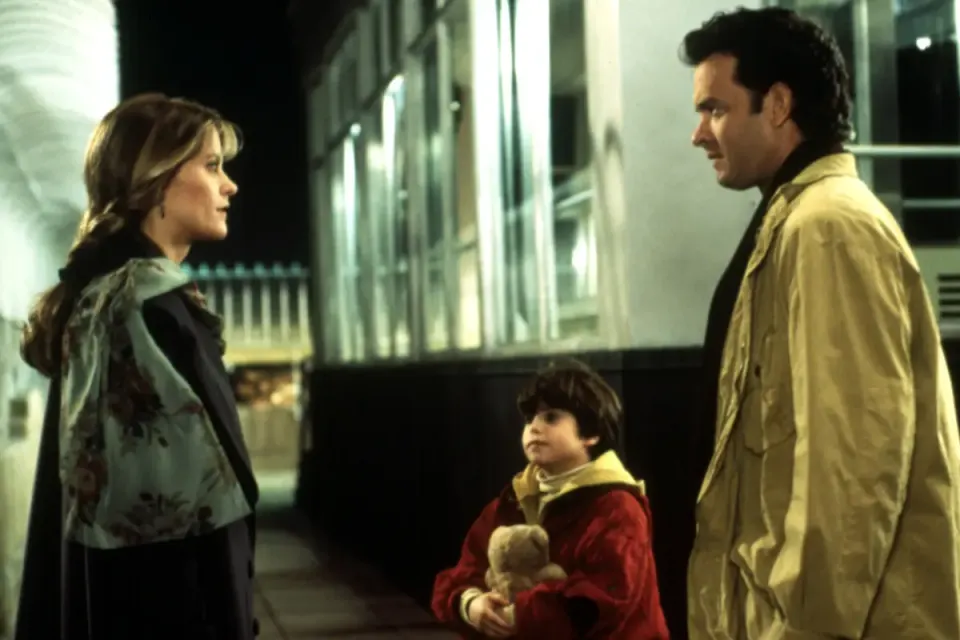
While Nora Ephron’s You’ve Got Mail is explicitly about falling in love via the internet (but with a person you are unaware you know in real life), it’s really her 1993 hit, Sleepless in Seattle, that captures the spirit — and the madness — of online dating.
There’s a video of Ephron, somewhere on the Internet, where she talks about taking the romantic fantasy contained in the classic 1957 weepie An Affair to Remember (and Love Affair, the 1939 film of which Affair is basically a shot-for-shot remake) and creating a different fantasy: the idea that somewhere in the world, there is a perfect person for you and you might never meet them.
Annie Reed (Meg Ryan) happens upon a radio call-in show as she drives from Baltimore to DC on Christmas Eve and hears Jonah, an 8-year-old boy from Seattle who has called in because his dad “needs a new wife.” His dad, Sam (Tom Hanks), eventually comes on the line and Annie is touched by how he talks about his late wife and how much he misses her.
Over the next few weeks, Annie becomes increasingly obsessed with Sam (as do hundreds of other women across the country, who send him letters and photos) and believes him to be her destiny. All because the two of them said the word “magic” at the same time. (By this metric, autocomplete is my destiny.) She tries to write him a letter but finds it hard to say, “What if we, two strangers separated by thousands of miles, are destined to be together” in a way that doesn’t sound deranged. (Also, in the pre-Internet age, she can’t capitalize on the fact that she is Meg Ryan, in maybe her last role before she — no judgement! — fully morphed into the Meg Ryan persona, not so much a person as a collection of tics, mannerisms, and funky haircuts.) Her friend, Becky, (Rosie O’Donnell) finishes one of her abandoned drafts and sends it to Sam, who is uninterested in reading any of these letters. Jonah, however, takes an immediate shine to the idea of Annie presented in her letter.
Here we have some of the basic dynamics of online dating: An attractive public display, a flurry of messages, the indescribable sense that sometimes arises that you and this person you have never met have some kind of connection. The very idea of dating apps is that it can act as the ultimate sorting mechanism, filtering out the undesirables and leading us towards a destiny we might never have met otherwise.
In the scene below, Sam, the skeptic, basically makes the case for why it’s better to meet people in real life rather than on apps — or via the radio:
Truly deranged thumbnail image. Tom Hanks should protest.
In the very early days of the Internet, Annie can’t stalk Sam’s Instagram, so she uses her skills and resources as a reporter to learn basic facts about him (like his last name and profession — things that would be incredibly easy to find now) and hires a private detective to follow him around Seattle. (Truly deranged behavior!) Much like Instagram stalking, what she finds leads her to incorrect conclusions: She believes Sam to be in love with this annoying decorator he goes on a few dates with. She eventually flies out to Seattle herself, where she spies on Sam and Jonah playing on a beach and mistakes another curly-haired woman seen from behind (this time, Sam’s sister, played by Hanks’ real-life wife Rita Wilson) for the decorator. The two even have a brief, awkward meeting where Annie, unnerved by the presence of another woman, can only say “hello.” (Sam is taken by Annie, whom he spied previously at the airport and does not realize is the woman his son wants to fly to NYC to meet on the top of the Empire State Building on Valentine’s Day.)
At one point, Jonah, frustrated and annoyed at Sam’s refusal to go to NY, waves Annie’s letter in the air and shouts “This is the one I like!” a weirdly familiar feeling to anyone who’s suddenly decided they are maybe going to fall in love with a person on Tinder who shares some of their general pop culture tastes, if only that person returned their messages a bit more promptly.
It's all vibes. Annie is drawn to Sam because of random coincidences and the fact that she and Sam both find the radio psychologist, Dr. Marsha Fieldstone, annoying. Jonah has decided Annie is going to be his “new mother” because she — or is it really Becky, who finished and mailed the letter? — and his dad both think Brooks Robinson is the greatest third baseman ever. The film, however, signals that Jonah and Annie are reading the vibes accurately. In one scene, Sam recounts to Jonah that his mother could peel an apple “in one long, curly strip.” Later on, we see Annie, sitting at her kitchen table in Baltimore, peeling an apple in one long, curly strip. The film posits that these coincidences and minor affinities are actually incredibly meaningful, that some deeper essence is contained in seemingly superficial similarities. That Annie, in some way, is meant to be Jonah’s new mother and Sam’s new wife because she can peel an apple and likes Brooks Robinson. (Brooks Robinson died this year, and I was, like, “Oh man, Sam and Annie would be very bummed.”)
The characters are all under the thrall of cinematic depictions of love and romance. Becky and Annie (along with Sam’s sister) are obsessed with An Affair to Remember (that’s where the plan to meet on top of the Empire State Building comes from), and, at one point, Becky tells Annie, “You don’t want to be in love. You want to be in love in a movie.” Jonah has learned about sex from watching cable at his friend’s house and asks Sam if the new wife he will one day have will “scratch up [his] back.” Sam rejects the notion of going to NYC to meet “a woman who could be a crazy, sick lunatic” and asks him, “Didn’t you see Fatal Attraction?” (Rewatching some clips, Sam and Jonah have a…weird relationship.)
Ultimately, Jonah sneaks off to NYC on his own, forcing a panicked Sam to chase after him. (Who hasn’t convinced themselves to make a Grand Gesture for a total stranger that turns out badly and arguably puts one in physical danger?) Like Cary Grant in Affair, he sits for hours in the cold on top of the Empire State Building, with no Annie in sight. (We all must learn sometime.) Sam eventually arrives, and tells Jonah he needs to have a real “come-to-Jesus” moment about this random woman (the phrase “…from the internet” follows so naturally but is not accurate). Annie, in New York for a romantic weekend with her fiancé, Walter (Bill Pullman), ends the engagement and races to the Empire State Building to see if Sam is there. (Partially because she sees that the building is lit up with a big heart for Valentine’s Day. It’s, like, yeah, Annie, that’s what they do.) Sam and Jonah have already gone, but they have left Jonah’s backpack behind and return to claim it, finding Annie. The lovers meet, the music — the theme from An Affair to Remember — swells, Jonah is very pleased with himself. The vibes are excellent.
At the risk of turning this into a random act of nonfiction, this movie holds special significance for me. It was released in 1993 (in the summer, I think?) which was right in the middle of my parents’ contentious divorce, which ultimately dragged on for a total of two and a half years, becoming final only in mid-1994. It is also, I think, maybe the only movie I ever saw in a theater with my father. My mother had taken my two older sisters to North Carolina for soccer camp, and while I had accompanied her for the drop off, I didn’t want to go for the return trip. I initially stayed at my grandmother’s but quickly got home sick and ended up at my father’s house in Lexington, where I got very comfortable with all the pizza, cable TV, and benign neglect. I stayed on even once my mother and sisters had returned. They went, without me, to see Sleepless in Seattle, a movie I had expressed contempt for when it was raised as a possible outing. (I believe I had said, in the parlance of the time, “Gag me with a spoon.”) Upon hearing they had gone without me, it became the only movie I wanted to see. I cajoled my father, not really the movie-going sort (though at this point he could still actually go to a theater, which would not be true for all that much longer), to take me. There’s a scene where Tom Hanks is working up the courage to call the decorator to ask her out, and “Back in the Saddle” by Gene Autry plays in the background. My father, a man not yet divorced but also in no way single, laughed heartily at this, which I always remember. It was not a joke I understood.
(In a strange coincidence, Ephron and my father died within a month of one another, both of respiratory-related causes, in the summer of 2012. Ephron had, it was revealed, hidden her illness (myelodysplasia) for nearly six years for fear it would hurt her career. I can recall Meryl Streep, at Ephron’s memorial service at Lincoln Center, expressing outraged grief that Nora had left without letting any of them say goodbye. My father did not hide his illness, but he had also not been seen in public since my sister Annie’s wedding in 2005.)
I think I saw it at least one more time in the theater and when it was released on video, I rented it again and again, watched it so many times I had it memorized. (Even now, I can recall its first lines: “Mommy got sick. And it happened just like that. There’s nothing anybody could do. It’s not fair. There’s no reason. But if we start asking why, we’ll go crazy.” I also listened to the soundtrack constantly, which, filled as it is with jazzy standards — “As Time Goes By,” “Stardust, “Bye Bye Blackbird” — is probably one of the reasons I have old man tastes. “Bye Bye Blackbird” — featured in the dubbed scene below — has been at the top of my "En Boucle" playlist on Spotify for a while now.)
If I had to guess what little Lauren found so appealing about this movie, it’s probably not the fated lovers brought together by an increasing obsolete broadcast medium. I think I probably related to Jonah’s grief, since that is clearly what’s driving his desire for Sam to get remarried, and what’s behind his obsessive focus on Annie. At one point, in the scene where Sam mentions the apple peeling (coincidentally, the scene in the video above), Jonah admits that he is starting to forget his mother, who has been dead for more than a year. It’s not just that Jonah no longer has a mother; her memory is slipping away, leaving him truly motherless. His father, Sam, is very caring, but Sam’s grief is expressed primarily as peevishness and a lack of curiosity — he is annoyed with everyone, including Jonah, and rejects the very idea of romance– and he treats his son more like a peer than a child. (Jonah calls in to the radio show because Sam isn’t sleeping.) Otherwise, Jonah has an aunt who lives far away and a weird, goth babysitter, Clarice.
I had not lost either of my parents, but my world had been cracked open. My parents had barely spoken or even interacted for the last few years they lived together. (A fact that only became apparent to me on the day they announced their separation to me and my sisters. I, who had been told by my mother earlier in the day, walked into the living room to see them engaged in a tête-à-tête, seated across from each other and leaning towards one another, in confidence. It was an image that struck me, because it was entirely new to me.) My father, it was revealed (by my mother, natch), had been having an affair for five years with a junior associate at his law firm, a woman I knew and who had often played with me on the relatively rare occasions I visited the office. (And who, I should mention, is now my beloved stepmother.)
Jonah has clearly lost something, though the lost object is fading from his memory. I had also lost something, but what I had lost had also been revealed to be rotting from within and not worth very much — a barely maintained facade. Jonah is looking to put his family back together (and, maybe, find someone to take some of the burden of supporting his dad.) It’s less clear what, if anything, there was for me to reclaim. The 90s involved at least a few of those “children scheme to reunite their divorced parents” movies (The Parent Trap, All I Want for Christmas) and the wish fulfillment these movies held for me was not the idea of a family un-fractured but rather the idea that you’d want your parents to reunite at all. I preferred they mostly stay away from each other. Unlike the kids in these films, I had no old family movies to watch wistfully in the dark and yearn for happier times. There were no good ole days, or none since likely before or shortly after my birth.
I also think I envied Jonah’s agency. Like, Jonah is making things happen. Calling into a radio show (more than once!), turning his father into an object of national feminine curiosity, fielding calls and letters from women from faraway cities, whittling it down to one good prospect, and feeling utterly entitled to make demands upon Sam, who can barely care for his own emotional needs, much less Jonah’s. Jonah is writing grown women letters and booking cross-country flights for romantic rendez-vous. I just got shuttled from house to house and tried to make myself as small as possible. In real life, kids are completely subject to their parents (and Jonah himself has been dragged across the country in the wake of his mother’s death, as Sam cannot stand all the memories of his late wife in Chicago and, like, dude), but Jonah is the prime mover in the Sleepless in Seattle universe. Without him, nothing else happens.
(The film’s end allows the fated lovers to meet, but it also resets Jonah and Sam’s warped relationship. Sam, who has been not exactly cruel but very dismissive of Jonah throughout the film, finally reclaims his role as a father and shows some vulnerability. In the film’s most touching moment, he rushes to the observation deck and grabs Jonah by the shoulders. “What if I couldn’t get to you? What if something had happened to you? What would I have done? You’re my family. You’re all I’ve got.”)
My OCD was also probably already presenting then — looking back, I used to love to play “parking lot” with all my toy cars, lining them up into these neat little rows, where one car would leave and another would come take its place, a process I found very satisfying — and the movie’s belief in a system of signs and symbols you can decode to reveal truths and riches would have appealed to me. (Or might have seemed a way to avoid ever being so blindsided again.) In its way, fate or kismet is the mirror image of anxiety, but where your attention can guide you to some longed-for destiny rather than alert you to signs of imminent ruin and collapse. In both cases, constant vigilance is required, lest you miss an important message from the universe.
There must have been something very comforting in the idea that, through sheer force of will, a kid could radically transform their miserable life.
I see Sleepless in Seattle get dinged online for the lovers not meeting until the end of the film, as though it fails as a guide for how to find love in real life. But, frankly, Nora Ephron was not trying to show you how to find lasting love! She was just creating a fantasy, much like Jonah and Annie. The movie comes close to something instructive. Sam and Jonah could have left the backpack, and headed back to the airport and Seattle to try to build a new life as a duo. Annie, alone atop the Empire State building, could have pondered the dangers of alluring fantasies, maybe tried to get Walter back, or just tried to find someone more appropriate in her own ZIP code. But, like, what fun would that be? Little Lauren would not have been so taken with that. It would have provided no comfort. Like, facing unpleasant realities was just my day-to-day existence. Instead, the elevator doors open back up, the fantasy comes true, the signs and symbols were right, that gut feeling was vindicated. Everyone’s projections onto everyone else? 100% correct.
Pondering my own romantic failures, I can say that memorizing this movie as an 11-year-old didn’t really set me up for success. But, ah well.
The film ends with the elevator doors closing on the trio as they descend from the observation deck of the Empire State Building. It’s unclear how they will handle the details of this new courtship. As anyone who’s been on a dating app knows, it’s can be quite exhausting to try to form an enduring connection with someone with whom you share no existing social context, much less with someone with whom you do not even share a regional context. Challenges remain but Ephron does not care about them. That's not her business.
Member discussion