Dancing in the gale
Note: This was meant to be published closer to the New Year, but I struggle to finish things.
Like it was for many people, 2023 was a difficult year for me. But it didn't *suck* for me, and I'm not mad at it, because I didn't have any expectations that it would be anything but difficult. It's very seductive to imagine that a brand new year will bring about radical change in yourself or your circumstances, but it's rarely the case. Change is usually slow, even imperceptible.
I went into 2023 with no illusions about it being my year. This is because the second half of 2022 had, despite some outward signs of progress and achievement (new job, new condo, half marathon), been trending very negatively for me. Q3 was just very miserable (almost from start to finish) on a personal level, and Q4 ended with me trapped for 10 days in the middle of nowhere with my mother, both of us sick with Covid, Christmas cancelled. (Festivities could proceed without Aunt Lauren, but not without Grandma or her house.) As the New Year mercifully approached (and I drove back to Maine), I figured these trends would continue into 2023. The winds were just not favorable.
And continue they did. I developed a serious dust allergy (not great when living in a condo that was built in 1922 and had been inhabited previously by a 24-year-old who did not own a vacuum), my still new-ish job was overwhelming and very frustrating, the new condo was overwhelming, and there was still some weirdness (even if only in my head – and also absolutely not just in my head) from the shittiness of Q3 of 2022. But because I hadn't really expected anything else (and, partially, because life had frankly beaten the impulse toward optimism out of me), I was able to weather the continued storm with (somewhat) more equanimity than I would have otherwise. When some new complication appeared, I was like, "Yes, of course."
In the last couple of years, much of my reading has focused on mindfulness or Buddhism-related texts. During this year, I read – or listened to – Pema Chodron's The Places That Scare You: A Guide To Fearlessness in Difficult Times. A major theme of the book is the idea of groundlessness, of accepting that there is no such thing as true security or safety because everything is changing all the time. As soon as we find purchase on what we believe to be solid ground, it shifts beneath us – or dissolves entirely – and we are tossed once again into the tumult. Our impulse is to hold on to what is no longer there, even as we risk falling into the abyss. Wisdom impels us to let go and to recognize that, no matter where we land, it too will be temporary.
This is echoed in another book I read in the summer, Mark Epstein's The Trauma of Everyday Life. Epstein is a psychiatrist and his books concern how he applies Buddhist principles to his work as a therapist. In this quote, he's speaking about the persistence of trauma, rather than the illusion of security.
[Trauma] is not something to be ashamed of, not a sign of weakness, and not a reflection of inner failing. It is simply a fact of life.
This attitude toward trauma is at the heart of the Buddha's teaching, although it is often overlooked in the rush to embrace the inner peace that his teachings also promised. But inner peace is actually predicated upon a realistic approach to the uncertainties and fears that pervade our lives. Western psychology often teaches that if we understand the cause of a given trauma we can move past it, returning to the steady state we imagine is normal. Many who are drawn to Eastern practices hope that they can achieve their own steady state. They use religious techniques to quiet their minds in the hope of rising above the intolerable feelings that life evokes. Both strategies, at their core, seek to escape from trauma, once and for all. But trauma is all pervasive. It does not go away. It continues to reassert itself as life unfolds. The Buddha taught that a realistic view makes all the difference. If one can treat trauma as a fact and not as a failing, one has the chance to learn from the inevitable slings and arrows that come one's way. Meditation makes profound use of this philosophy, but its utility is not limited to meditation. As my patient realized when grappling with his diagnosis, the traumas of everyday life, if they do not destroy us, become bearable, even illuminating, when we learn to relate to them differently.
That's what I spent 2023 trying to do: learning to relate to things differently. To hold onto them less tightly. To accept that certain challenges would always be challenges and that loss was inevitable. In another passage, Epstein describes a visit to Ajahn Chah, a renowned Thai forest master, whom he asks what he has learned from 30 years of contemplation and study.
Before saying a word, he motioned to a glass at his side. 'Do you see this glass?' he asked us. 'I love this glass. It holds the water admirably. When the sun shines on it, it reflects the light beautifully. When I tap it, it has a lovely ring. Yet for me, this glass is already broken. When the wind knocks it over or my elbow knocks it off the shelf and it falls to the ground and shatters, I say, 'Of course.' But when I understand that the glass is already broken, every minute with it is precious.'
One day at work happy hour, I was chatting with one of my Gen Z coworkers. They told me how they couldn't really believe their life – they loved their job, their girlfriend lived a few blocks away from them, and they ran into their best friends at the 7-11 down the street. They couldn't imagine not living where they lived and doing what they did. (I recognize this sounds insufferable, but they are very charming.) But storm clouds were gathering in the distance: one of their roommates was about to finish law school and head back home, wherever home was, and another had ideas about going out west to hike some trail. Thinking of how it all might end, they said, almost felt like death.
"You should just enjoy it," I said. "You don't know what will happen." I didn't tell them about Ajahn Chah and his glass that was already broken (I try not to get too weird at work), but I think they understood it implicitly. They weren't wrong to think of the end of this part of their life, whenever that occurred, as a kind of death. We experience many such deaths before we die. But clinging to something that is no longer viable only extends our grief. You just have to cherish it while it's here and then let it go. It's possible that what takes its place will be even more precious to you, but it's just as possible that you will find it disappointing and unsatisfactory. You have to let go all the same.
Another quote, that gets at the same notion. It's also from The Trauma of Everyday Life, but it's a quote from Stephen Batchelor. Google informs me it comes from his book, Living with the Devil: A Meditation on Good and Evil.
When the stubborn, frozen solidity of necessary selves and things is dissolved in the perspective of emptiness, a contingent world opens up that is fluid and ambiguous, fascinating and terrifying. Not only does this world unfold before us with awesome subtlety, complexity, and majesty, one day it will swallow us up in its tumultuous wake along with everything else we cherish. The infinitely poignant beauty of creation is inseparable from its diabolic destructiveness. How to live in such a turbulent world with wisdom, tolerance, empathy, care, and nonviolence is what saints and philosophers have struggled over the centuries to articulate. What is striking about the Buddhist approach is that rather than positing an immortal or transcendent self that is immune to the vicissitudes of the world, Buddha insisted that salvation lies in discarding such consoling fantasies and embracing instead the very stuff of life that will destroy you.
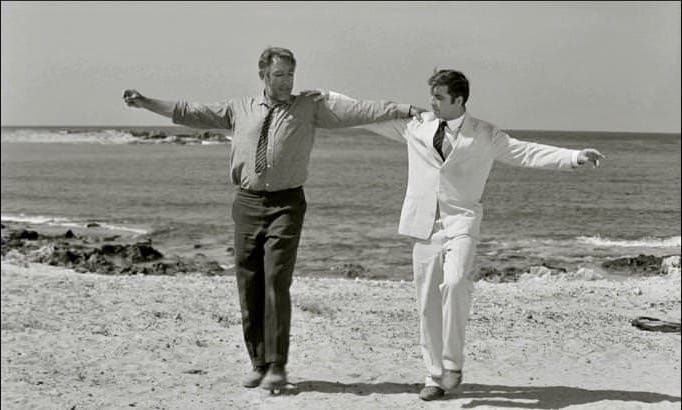
One of the most famous mindfulness books is Jon Kabat-Zinn's Full Catastrophe Living, the title of which is a reference to a line in the film Zorba the Greek. As Wikipedia describes, "The title character says, in response to being asked whether he has ever married, "Am I not a man? Of course I've been married. Wife, house, kids ... the full catastrophe." Kabat-Zinn explains:
Zorba's response embodies a supreme appreciation for the richness of life and the inevitability of all its dilemmas, sorrows, traumas, tragedies, and ironies. His way is to "dance" in the gale of the full catastrophe, to celebrate life, to laugh with it and at himself, even in the face of personal failure and defeat. In doing so, he is never weighed down for long, never ultimately defeated either by the world or by his own considerable folly.
When compared to the global tragedies currently underway, the travails of my personal life are not of great concern. But they are obviously of concern to me. What struck me about many of the things that happened to me in the past 18 months is that, in their very small-scale way, they managed to be so much worse than even I, a very anxious person, imagined they would be. I would try to use my little coping skills and reassure myself and say, "Well, yes, Lauren, this is happening, but certainly X won't happen." And then X, or something that was even worse than X that I had not anticipated, happened. And, while I'd obviously probably prefer that none of these things happened (I seek pleasure and ease and avoid pain as much as the next person), there was something funny about how my little worst nightmares kept coming true. It forced me to let go of the illusion that I had control over anything. Eventually, I had to laugh – "Yes, of course!" And, once I had laughed, I was relieved to find out that while I might be embarrassed, I might be sad, and I might be angry, I was also basically fine. I could survive all of those things.
Things have certainly improved since the nadir of the fall of 2022 (I've not only laughed about these events but made others laugh in the retelling, which has been very satisfying), but 2024 will unquestionably bring – and has already brought – more of the full catastrophe (and not just in my dating life) and we're all going to have to keep dancing in the gale.
Member discussion