In Defense of Dating Apps
I don’t really know what’s in the water, but dating apps are really taking a hit right now. Like, people are just so angry about them. As though the apps have injured them personally.
I think dating apps can be very valuable. They’ve been really helpful to me. However, what they can offer you is not what they’re selling. Like, it is really very unlikely that you, specifically, will find a serious romantic partner on them and it’s not even guaranteed you’ll find a casual hookup, if that is what you are seeking. (But it’s possible! Like, lots of people have done it, which I think throws off everyone’s expectations.)
The stats you see out on the Internet are pretty misleading – they show that more couples are meeting online (I think it’s well above 50% now) but don't mention that, overall, a pretty small percentage of dating app users meet a spouse or committed romantic partner. (I’ve seen something like 10-15 percent.) The odds are not in your favor.
And that isn’t really the fault of the apps. Like, the primary factor in you finding a person you connect with and are compatible with (and who would never dream of leaving you on read) is…luck. And there’s nothing you can do to make yourself lucky. You just have to wait. The Supremes sang a whole song about it.
Everything that is, in theory, appealing about dating apps – they allow you to connect with people outside your existing social network, they allow you to gauge more easily someone’s interest in you and to express interest in others in a direct but low-stakes way – is also the cause of almost everything that’s unpleasant about them. At the same time, the things that are unpleasant about them – the ghosting, the disappointment, the boredom, the awkwardness, the promising things that blow up in your face – are also what make them a really useful space for growth and development. For, yes, practicing mindfulness.
That’s the thing: Dating apps are for practice. They are like going to the gym for your feelings. For your communication skills. For your (maybe slightly too porous or slightly too rigid) boundaries. A place where you can build strength and endurance, target certain muscles that you’ve either neglected or never bothered to develop in the first place, and nurture your confidence. Let strangers say nice things to you, but don’t expect too much of them, or of yourself. Go out with someone who’s maybe not your type, but don’t expect to fall in love. Don’t expect anything, actually, and you might be surprised what you find.
This idea of practicing isn’t mine. Following some disappointing and triggering experiences, I read a couple of things that were really helpful to me and allowed me to change my perspective on dating apps – how to use them and what they’re even really for. The first, is from a conversation about rejection between Andrea Long Chu and Brandy Jensen, from August of 2022, at the LA Review of Books:
ALC: No, I did not. I met my girlfriend through the sheer power of will. But I mean … I do think that I made the apps work for me in the sense that it was about practicing a kind of openness and, like, being ready. The readiness is all.
BJ: Can it make you ready? I feel like I’m too ready.
ALC: Obviously, when you’re on the subway platform and you’re just swiping through, it can be miserable — but it’s just kind of practicing being ready for it to happen. Because you don’t know, and you do need to be ready. I do think that in principle, it’s almost always better meeting not on the apps. But I think you can derive a certain kind of value from it. It was very helpful in practicing flirting.
Around the same time (but not actually because this was not published until February of 2023, several months later, what even is time), I saw this newsletter from Margeaux Feldman, aka Softcore Trauma on Instagram, about “the praxis of disappointment” on her Substack, Carescapes.
One of the hard truths about opening ourselves up to intimacy is that we will be disappointed. Intimacy, if we so seek it, requires us to practice being disappointed — to build our capacity to experience this emotion. Because, the other side of possibility is disappointment. We can’t have one without the other.
As someone who's been meditating for many years now, I obviously found this idea of "practicing" appealing. Meditation is a practice, where you learn and apply a technique in a specific, low-stakes setting and you can then use that technique in other ways or in more high-stakes situations. Instead of noticing when you've become distracted and redirecting your attention back to the breath, you might notice when you're making assumptions about someone you just met or falling into a spiral of negative self-talk. You can then interrupt these habitual thought patterns and see things more clearly, be less reactive. There are guided meditations that are specifically geared toward dealing with difficult emotions; in them, you are directed to think of a moderately difficult situation in order to trigger a response that you can use to practice the technique. Once you know the technique, it will be easier to apply it to more difficult or even traumatic situations.
This is one way dating apps can also be useful and how they can turn their supposed disadvantages – for instance, you don't meet anyone you really like – into advantages. After all, meeting someone you really like is actually very stressful. That is not a situation where you want to practice something for the first time. You would like to already be pretty good at it. But even the remote prospect of romance creates a tension – a weightiness – that can be constructive, that allows you to practice certain skills under a moderate amount of pressure. What skills? Accepting disappointment, obviously. Like, it sucks to be ghosted, even by someone you were only meh about. But, hey, you can practice getting better at it (for when someone you really like does it). Other skills: setting boundaries, communicating interest (or the lack thereof), developing patience, being vulnerable, accepting the vulnerability of others, all sorts of vaguely squishy things that cause discomfort.
And once you get better at them, it's much easier to keep engaging on the apps because you're less afraid. You become more confident in your ability to manage whatever comes up. You get better at reading other people; their behavior becomes less surprising. Like, most people Ain't It. (And I mean that in the kindest way.) It's helpful to be able to recognize that early on.
I think the best approach to to either making friends or, likely, finding a partner (I am still single): It’s not that you have to stop looking. The looking is important. If you don’t look, you won’t find anything. But while looking, you have to let go of whatever it is you are searching for. You cannot become attached to particular outcomes. You have to do it for the doing, not for the eventual reward, which will come in time and probably when you least expect it, which is different from when you stop looking. (Though, for the record, I have also stopped looking but not because of despair, exactly. I just would rather do other things. Though, I will admit, the re-election of Donald Trump and the death of my beloved cat has left me in dire need of something to snuggle, so we'll see how long I can hold out on either re-joining the apps or adopting another cat.)
In her book, Real Life, Sharon Salzberg writes about a common parable in Southeast Asia about someone who goes into the forest to search for a bird. Salzberg continues:
As the parable unfolds, the attempted capture is unsuccessful but it's not fruitless. It turns out that it's fine if the person doesn't actually capture the bird. The lesson is that because of all the wandering through the forest, the seeker of the bird has learned the ways of the forest.
The same is true in online dating: you're searching for a bird, but you're really learning the ways of the forest. In addition, embracing the process will keep you from getting disappointed, frustrated, and burnt out. In some of the content I see on Instagram, people despair over every “failed talking stage,” every first date that didn’t go anywhere. Like, ugh, again? And, yes. Most “talking stages” fail. (Also, stop calling it a “talking stage.” The youth just keep inventing terms to make themselves feel bad and create more distance between them and their emotions.) Most first dates don’t go anywhere. Even promising connections can quickly sputter out. If you accept this as normal, as expected, then you can stop desperately grasping at every potential friend or partner you see, thinking MAYBE THIS TIME.
Instead of trying to rush through all the preliminaries – to chat on the apps just enough until it’s permissible to ask them to meet up, to go on enough dates to become exclusive – enjoy what is actually happening now. Take an interest in the person you’re talking to as a person, not as the potential solution to a long-term problem. Like, find chatting on the apps excruciating? Have you tried asking more interesting questions? Have you thought about giving more authentic answers? I’ve had lots of really great, rewarding conversations on the apps, many with people I never met in real life. (None of this “Happy Monday!” shit. And I cannot flirt or recognize when someone else is flirting with me (autistic), so I wasn't doing that either.) Despite what some dating coaches might say, there’s no need to optimize everything for the outcome you want – that’s the road to failure.(Or it’s a way to exhaust yourself on the road to a success you would have found anyway. Like, you can only do so much – luck is the most important variable, which people hate acknowledging. All this strategizing is really just anxiety management and magical thinking.) Don’t focus group yourself to meet some ideal you just made up in your head and projected onto someone you’ve never met. Like, this isn’t actually a game you’re trying to win by accumulating the most points. You’re seeking someone who will appreciate you for who you are, not who you pretend to be. Like, be weird! Be off-putting. Most importantly, be curious. Don’t map out some perfect future in your head. As Ram Dass would say, be here now and remain open to what might develop. (But probably won’t.)
Beyond the numbers, I think there are structural things about dating apps that make connections formed there less likely to thrive or be sustainable. Connecting with someone outside your social network means you have no social trust. There's no one to vouch for this person, or to clear up misunderstandings. When you meet someone in your broader circle, there exists an entire social infrastructure that can support that connection. People who meet on an app must shoulder the burden all by themselves and I feel a lot of connections collapse under their own weight before they can gain any momentum. Anxiety, again, plays a role: people are so eager to know if things will develop, or if they will be rejected, that they press ahead in pursuit of certainty or security, and the level of intimacy (physical or otherwise) that results is usually too much for the existing level of trust and friendship. Much like Wile E. Coyote, you get so focused on the prospect of the elusive Roadrunner that you realize way too late that you ran out of cliff a while ago. Meep meep!

Wile E. Coyote is, in fact, extremely representative of the unskillful actions we take in pursuit of our desires and the harmful patterns we can't help but repeat. For instance:
The dawning realization (his little face!) that you have been ghosted:

When you keep texting them even though they haven't responded to your text from three days ago:

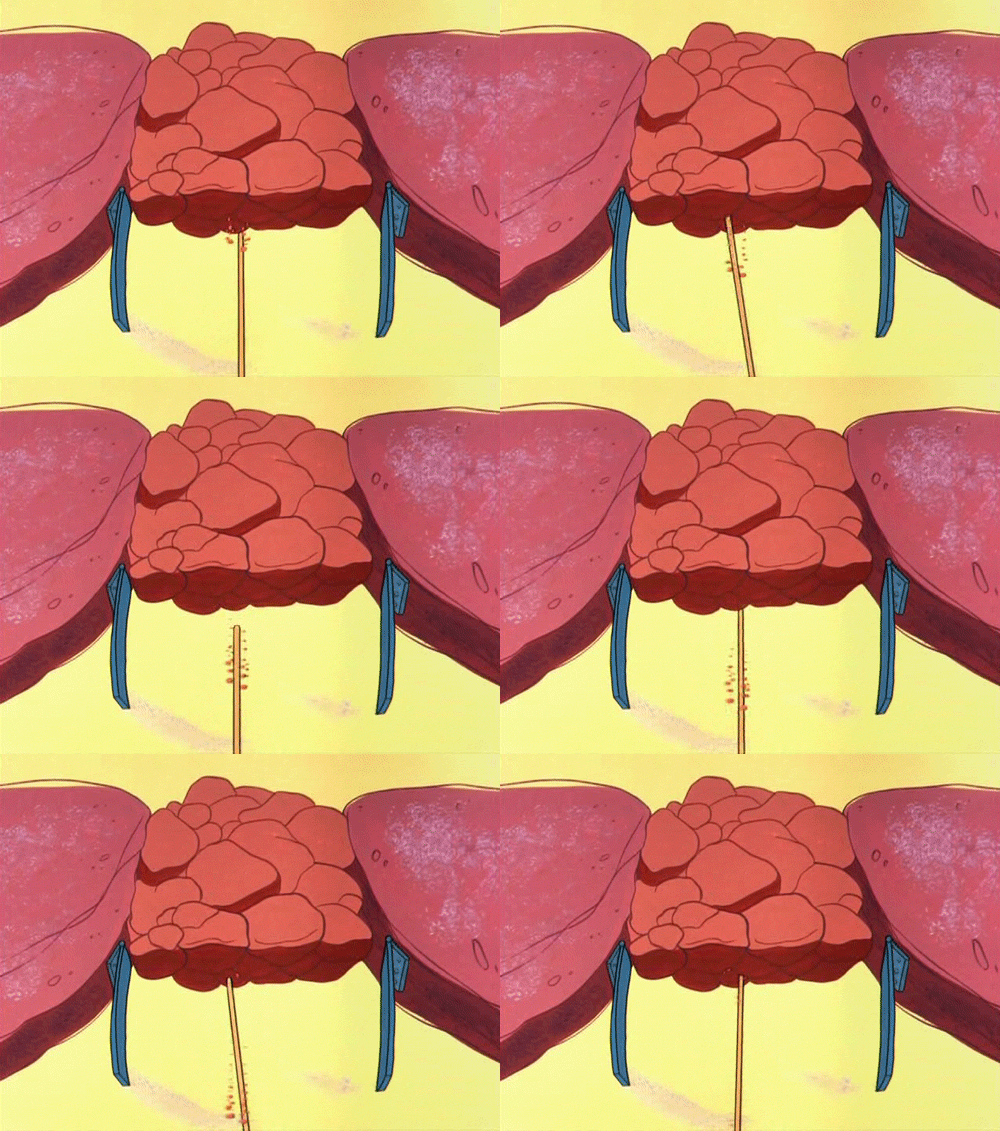
The inevitable result (The boulders were supposed to fall on the Roadrunner, obvs):
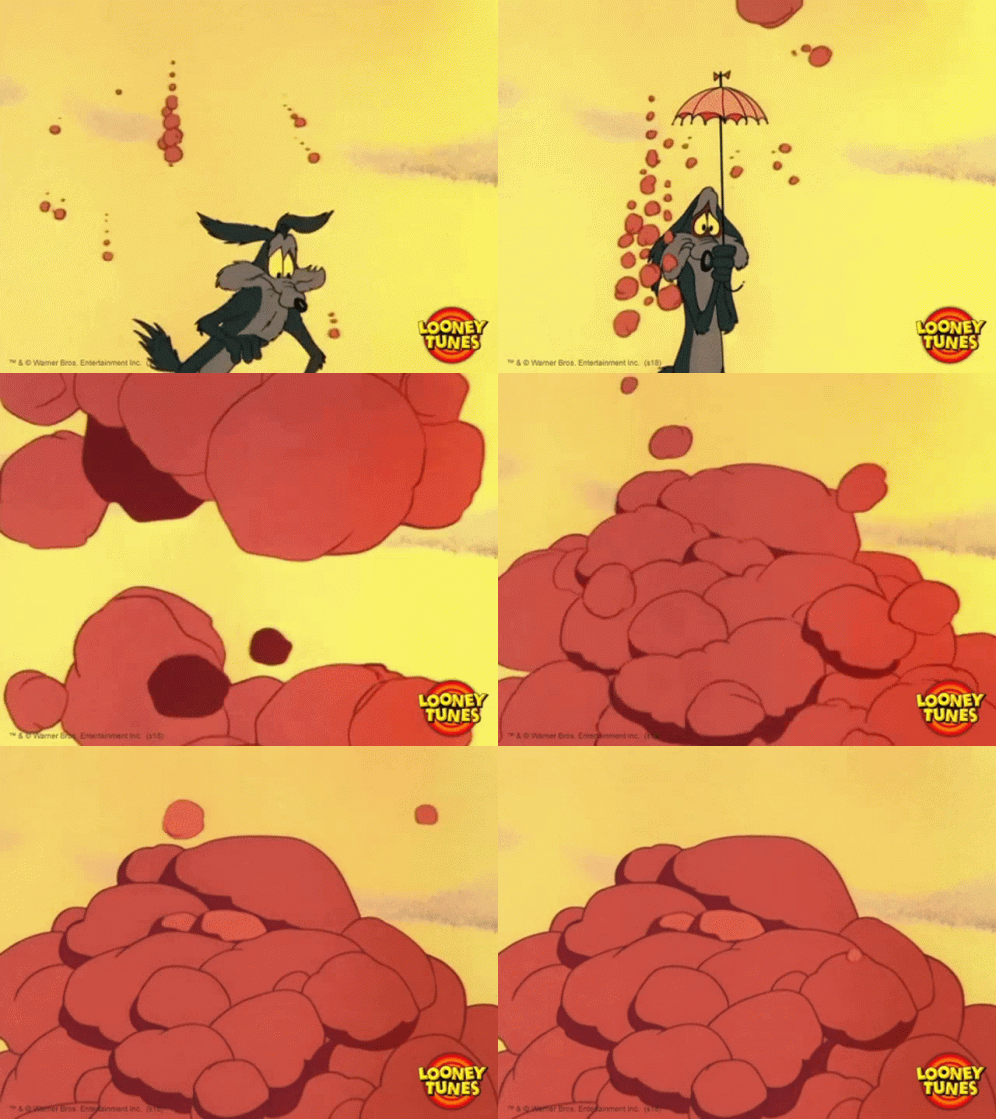
When you create a false image of yourself on a dating app to attract more people, but you're the only one fooled:
When you play it cool to seem remote and mysterious but they just think you're uninterested:
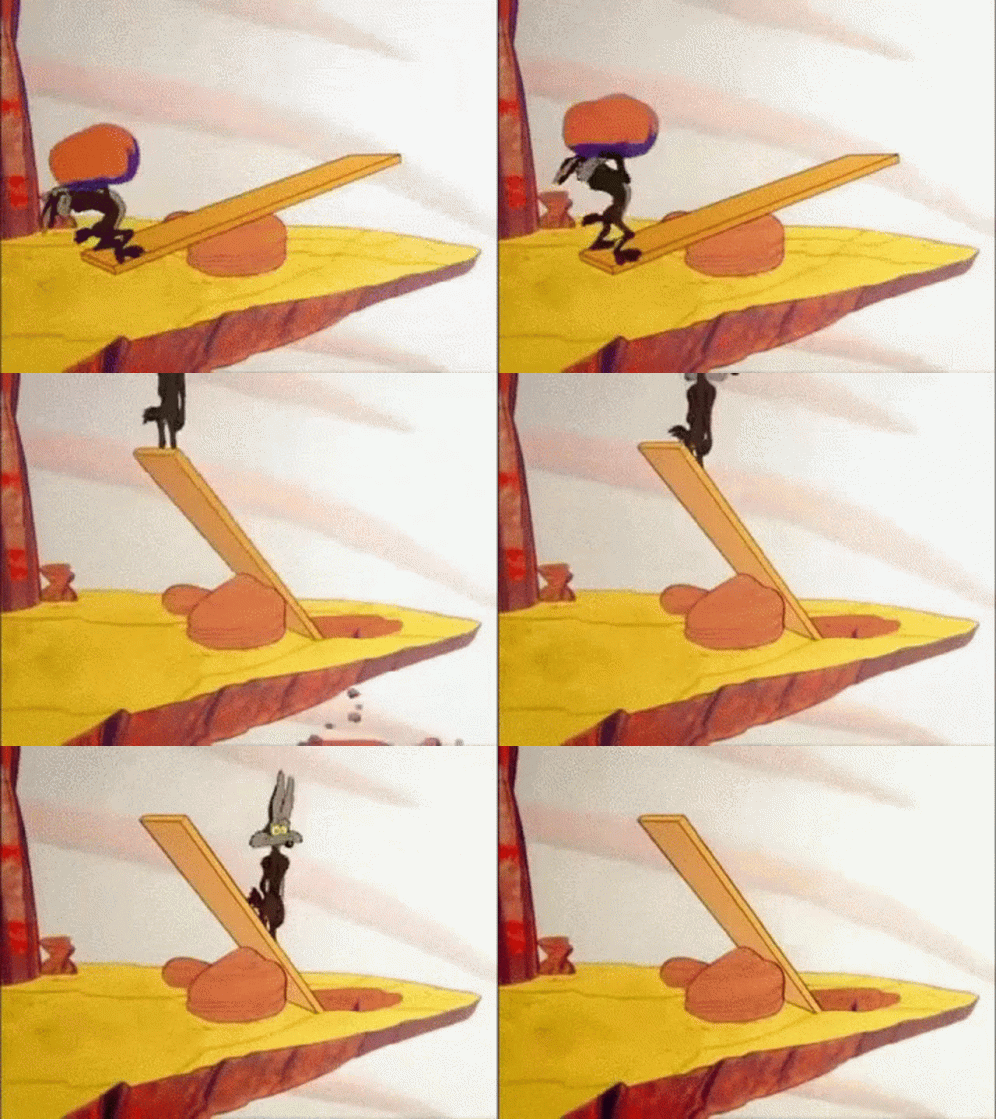
(I love him so much.)
However, if you accept these facts about dating apps, there's lots you can get out of them. They can even serve as a therapeutic tool – a tool for growth and, yes, healing. If I were to write about how I've used them, the terrible click-bait title might be "How I Used Dating Apps to Develop Secure Attachment – With Myself!" This does require some strategy – but not against other people, whether prospective dates or your perceived competition – but rather against your own core wounds and bad patterns. (I'll discuss this in more detail in future posts.)
I've already compared the apps to the gym, but here is one last reframe. I've been volunteering at a local animal shelter for a little over two years – I started around the same time I started the dating app experiment. Now, it's true that some volunteers/shelter staff adopt the shelter pets. That absolutely happens and with some regularity. But the majority of the shelter animals are not adopted by volunteers or staff, but rather by members of the general public who have not yet arrived on the scene, or even by the very owners who initially surrendered them. (I remember this very beautiful, standoffish, sometimes hostile cat named Baby, who reigned alone in Cat Colony 3 for months – off limits to volunteers because she was unpredictable – until her previous owner, upon hearing that she had not been adopted, came back to claim her.) As volunteers, then, our job is not to love these cats or dogs forever or take them home, but rather to show them some affection and care for the time they're with us. To get them more amenable to the idea of human connection, since many of them have never known that before or their previous experience of it has been very negative. (And, like, same.) We show them a little love (without expectation or obligation on either side) and then send them on their way. (And some, like my beloved Wallaroo, go to this nice cat sanctuary where they have the option of human interaction, but not the expectation or obligation. Others live the barn life. Not everyone is meant to be domesticated.)
On dating apps, we are all, simultaneously, both the shelter pets and (ideally, at least) the volunteers and it's unlikely that any two of us will be going home together to live happily ever after. (But it does happen – probably roughly 10 to 15 percent of the time.) In the meantime, however, we can show – at least make the attempt to show – each other some care, some respect, and some affection, to get us ready for the people who will.
Member discussion