Ambient Noise
Writer's note: This is long but I, personally, think it's pretty funny.
April is – or was – Autism Awareness Month. It’s also about a year since I started to seriously consider that I could be on the spectrum. Before you ask: I did not diagnose myself from TikTok. And I have not received an official diagnosis, though all the online assessments I have taken say it is “strongly indicated.” As an adult, there are no real accommodations to be had and there are significant drawbacks to having those ICD-10 codes on your medical records. (Even more now!) I won’t be seeking a formal diagnosis.
Late-diagnosed, low-support-needs autistic people are trendy these days, to the point where people have become annoyed by it. There’s a palpable skepticism about it – and not just for autism but for ADHD as well. People seem to think anyone exploring the possibility is trying to claim some kind of specialness they don’t deserve or make excuses for what they haven’t accomplished.
I thought it might be useful to discuss what led me to consider that I might be autistic and how I think it has impacted my life and particularly my social experience.
In many ways, I do not fit the profile (but the profile is quite limited). I’ve always been quite verbal and I imagine I hit all of my developmental milestones right on time, though it’s impossible to say for certain because I was a pretty neglected child. I doubt anyone could say, for instance, whether I responded to my own name.
I also have always been relatively – emphasis on relatively – socially adept, though I think that is, to an extent, more an impression than an actual fact. Part of my masking has been a certain aloofness which has allowed me to smooth over any infelicities or misunderstandings through a practiced nonchalance. I hang back. I observe. I engage from an ironic distance. This gives me time to catch up with what’s going on and also tends to be a little intimidating, depending on the audience. “Cool” can cover up many things. I also think growing up in the South, where we have quite prescribed (if informal) codes of behavior made it simpler. The rules and their accompanying scripts were provided for me.
While not a very social person, I also have always been very interested in people and I think people – and their emotions – have been one of my special interests, partially because of the very codependent relationship I had with my mother as a child. I learned to read her moods, anticipate her needs, and compensate for her limitations, and I’ve brought those skills into other relationships and interpersonal dynamics. This can be read as being emotionally intelligent, and I guess I am, but it’s to an extent a learned intelligence. I’m very emotionally dumb in a lot of ways.
Some other indicators of varying levels of relevance:
- As a kid, I did play parking lot with my little toy cars, lining them up in little rows. One car would leave, another would take its place. I found it all very satisfying.
- My mother used to brag to other moms about how I could play by myself for hours and “not need anything.”
- In my family, I was known for being perceptive and observant, someone who spoke only when I had something to say. And that's partially true, but also, I realize now, I just had no idea how to enter a conversation without being explicitly asked. (Still don't!)
- Starting in about fourth grade, I got very into movies, and later TV, and by high school was taping an enormous amount of programming. I created this detailed guide to my library of VHS tapes that included the name of the episode, its original air date, the date it was recorded, and my own personal rating from 1 to 10. I would periodically reorganize it and sometimes transfer the episodes over to new tapes to ensure the commercials were edited out perfectly. (And this exhaustive engagement with pop culture no doubt helped me with socialization.) I recently thought I had outgrown such things, but then I was explaining to a couple of coworkers how I have this spreadsheet where I list anything I want to buy, including the price, the link to it, arguments for the purchase, arguments against the purchase, my final decision, and, if bought, how I feel about it once I have it. So, no.
- During the summers in high school, I hardly saw anyone – I retreated into my own world and it just did not occur to me to get in touch. Proximity has always been pretty important to me for maintaining friendships. (In this Mary HK Choi piece in The Cut about her own autism diagnosis, she talks about putting up a sticky note that says “Say hi to your husband” or something like that, and I don’t have an actual sticky note but for me it’s “Say something in the group chat.”)
- A common autistic experience is people thinking you’re funny when you don’t intend to be, and that’s probably been true of me since middle school, if not earlier, but I just sort of leaned into it. I say things just to say them, not to be funny, but I have gotten pretty good at predicting when people will laugh. At Christmas, we were discussing the fact that, unless me or my younger sister have children and give them our father’s name, that name will cease once we’re all gone, and someone asked me about my romantic prospects, and I said, in a very matter of fact way, “I’m not saying it’s out of the question, but it’s not looking good, no.” And that was legitimately a straightforward answer, but people laughed. And I can see how it’s funny but that wasn’t my intent. At my birthday last month, I described some lesbians as "having their fingers in a lot of pies," and that got a big laugh and started a discussion among my friends about whether I "meant" it and, like, I "meant" it in the sense that I knew it would get a laugh but I also said it because it is an accurate description of these people. I will sometimes be like "This is going to KILL" even though I do not, personally, find it all that funny, or the humor is in the sound or cadence of the words themselves, or certain associations they have rather than the direct implications. (For instance, others laugh at "fingers in a lot of pies" because the people in question are lesbians, whereas I think it's a funny expression on its own – and fun to say, with the springiness of the first syllable of "fingers" and the satisfying pop of the p in "pies" followed by the long, and, when I say it, somewhat elongated, vowel – and brings up images of pies cooling on windowsills in old Looney Tunes cartoons and Looney Tunes-ified versions of these dykes plunging their fingers into said hot pies. I also am playing with this clueless persona that comes quite naturally to me – part of the humor, after all, is that I would say something like that without understanding or caring about the implications. And I absolutely would! ) A coworker is very insistent that I do stand-up comedy.
- I completed all of the French content on Duolingo in about six months in 2020 and when people would ask me how I did that, I would be like, “I dunno, I just did?” Or they’d be like “Why did you learn French?” And I’d be like “I developed a crush on a French actress and thought that I should learn her language in case I ever encountered her.” (Seems very logical to me.) Language has also been a very helpful framework for me to think about social interaction Lots of autistic people talk about using scripts, but I approach it more like it's a foreign language. There's a grammar to it and if you internalize that grammar, it makes it much easier and allows you to manage a wider range of scenarios. But it's never going to be my native language. I may be able to ask where the bathroom is or manage certain low-level pleasantries, but more complex discussions will probably always be confusing. The idioms will always elude me.
- Autism is genetic and I think there’s a good chance my father was autistic (we are similar) and I have a nephew who also shows signs. My stepmother once told me that if my father was interested in something at work (they were at the same law firm), he would work on it 24/7 and if he wasn’t, there was nothing you could do to make him do it. (He was a senior partner at this time.) At first, I was like, “Ah, what a selfish, lazy asshole in nearly all aspects of his life.” But I think his brain was probably weird. He hated showering, smoked four packs a day and guzzled Coca-Colas (destroying both his lungs and his teeth), and had a deep knowledge of a wide variety of topics. When the original Nintendo was released, he convinced me that I wanted one and then stayed home – again from his job as a senior partner at a law firm – for a week to play Super Mario Brothers until his hands cramped up. (Level 8, no princess.) He was, like me, known for having an incredibly "short fuse" as a child but his anger as an adult was relatively rare and, in my experience, tied to small sensory irritations that led to unexpected eruptions. Despite having a lot of money, he had simple, bland tastes – he ate a lot of bologna sandwiches and pecan twirls. When we had burgers on the grill when I was a kid, his had to be extremely well done – almost a charcoal briquette by the time it was to his liking. (You could say he was anti-flavor.) In the last decade of his life, as his health went into steep, self-imposed decline, he was mostly confined to a couch – later upgraded to a small suite that had a bed he almost never used and a bathroom nearby – and sat for hours reading books, watching TV (unfortunately a lot of cable news) and playing poker online. He received guests but spent most of his time alone and was largely content in a situation that might have driven many others to despair. There’s a lot of talk about how it’s misdiagnosed in women and girls, but I think there are probably a lot of men like my dad who coast on privilege and different gender standards around eccentricities. (Being an upper middle class white man is the ultimate accommodation.) He was the social chair of his fraternity and also a total weirdo.
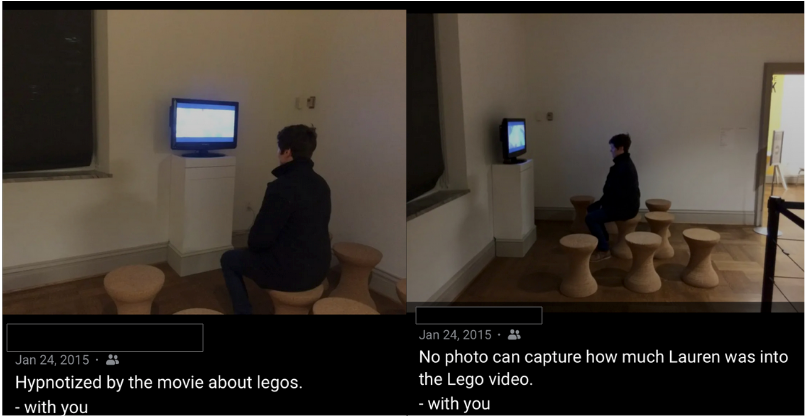
- Back in 2015, some grad school friends and I went to the Columbus Museum of Art and I became so transfixed by a video that accompanied a Lego version of the city that more than one person took a picture and posted to Facebook about it:
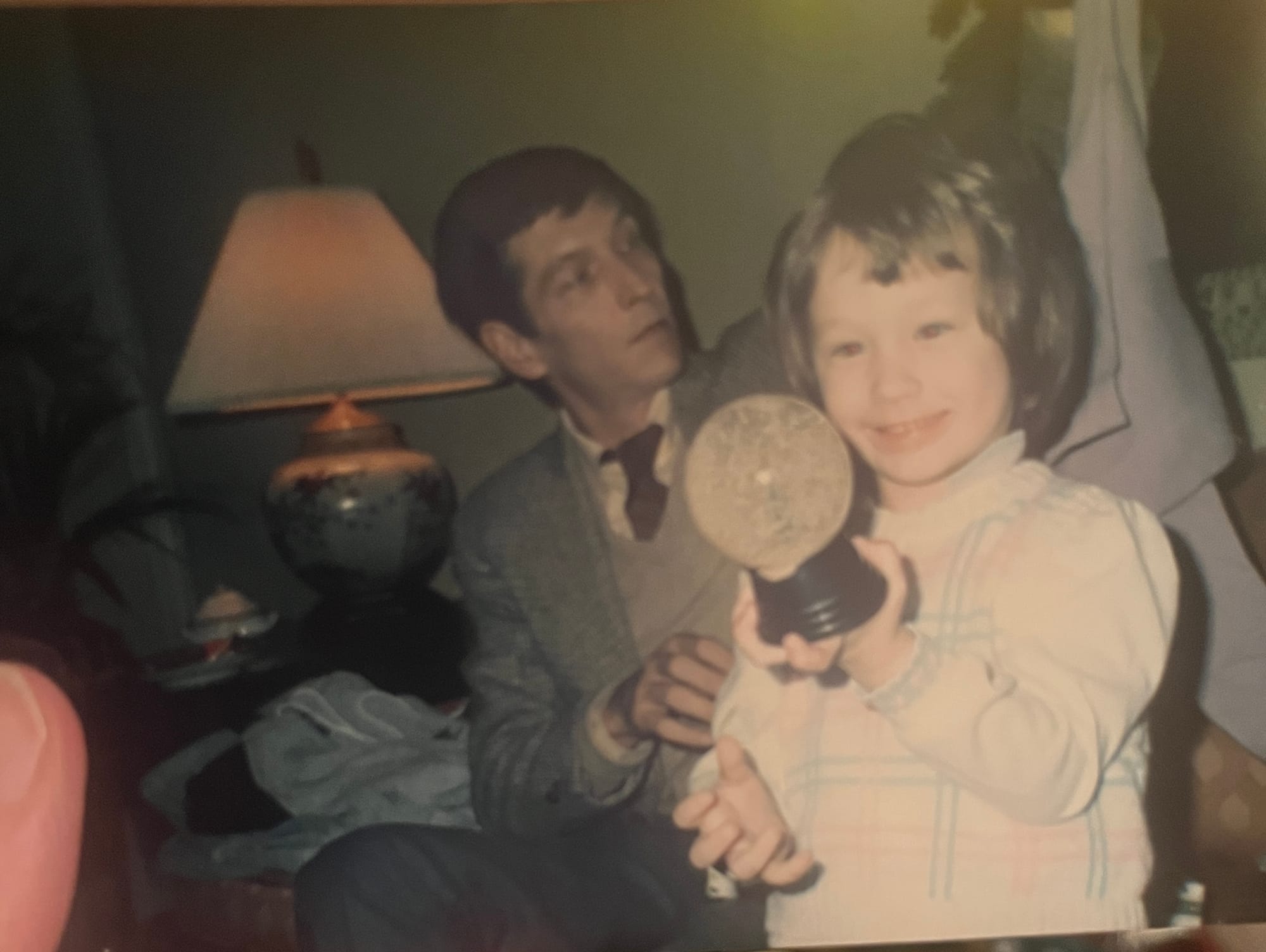
And, frankly, this photo of me looking at a snow globe at age 5 or 6 (Dad in background) has a similar energy:
Years ago, my friend Takara had asked, half in jest, whether I could be autistic. She described a party years before where, according to her (or according to someone else...who told her about it? Honestly, getting pretty apocryphal), I had objected to the music that was being played and had gone off to a chair in a corner and put on my headphones to drown it out. I had no memory of this. It sounds a little more rude than I would normally be, but I can’t rule it out. I could, especially at that time, be quite particular about music and, even now, I am semi-regularly driven out of a store or restaurant by the music being played over the loudspeaker or a nearby conversation that I can’t tune out.
But I had a very limited idea of what autism looked like at the time. Whenever the possibility was raised, I mostly dismissed it on account of one thing: the idea that autistic people can’t read facial expressions. Oh, that can’t be me, I said. I am completely beset by other people’s facial expressions.
But this is, in fact, very much in alignment with autism. Even my ability to read other’s emotions is not out of sync with the diagnosis. Some autistic people struggle with a lack of empathy; others (like me, I’d say) struggle with an excess of it. I am too subject to the moods and emotions of others; I can watch them flit across someone’s face with remarkable accuracy. This is a real hindrance to getting about my day. (Understanding the context and greater meaning of those emotions? Much harder.)
A (very limited, small sample size) study showed that autistic participants’ brains were taking in more information – about 40 percent more, at rest – than non-autistic, or allistic, brains do. In addition, autistic people’s brains may not engage in as much synaptic pruning, whereby synapses that are no longer needed are removed to make way for ones that are. These findings support what’s known as the “intense world” theory of autism.
This all makes a lot of sense to me, especially when applied to my own experience. When I was an adolescent, my mother described my brain as being like a computer – I had all this detailed information, but I had to summon it from some deeply buried directory.
This is how I would describe it: Imagine you press the shutter release on a camera that’s in continuous shooting mode and take dozens, if not hundreds, of photos of the same object over a short period of time.
Now, imagine all those images laid out on a table and someone says, “Pick the one that’s true.”
To mix my metaphors, it's all trees, no forest. And the camera never stops shooting – more images are constantly being added to the table, more trees to a forest whose shape and character is always shifting, at times dramatically, its true dimensions remaining ever so slightly beyond your grasp. As a result, you're in a constant state of revision. You have so many trees at your disposal that you can construct several very realistic-looking forests. But only one of them, if any, approximates the "real" forest.
To bring it back to facial expressions, am I supposed to believe the one that predominated? Or the one that briefly flickered across someone’s face and was quickly suppressed? They’re all true but not all of them are important and I struggle to understand what to believe, since they may also be contradictory. It seems allistic brains can easily sort through all this information – or never bother with those smaller details at all – and act on what’s important. They just know what’s going on. And facial expressions are only one kind of data you’re taking in: there’s also body language, tone of voice, etc. In a group situation, there are glances exchanged between people.
It’s not that the “truth” – the forest that everyone else sees quite clearly – is completely unknown. But it’s like it’s located in an adjacent room with a locked door and you can’t access it. Someone has to open the door for you. Or like snatches of a song you hear out of shop windows as you walk down the street – the individual notes are clear but the melody never coheres. Think of trying to Shazam a song in a room with a lot of ambient noise: it’s actually “Born to Run” but your brain is like “MMMbop”?
Mixed signals
Let’s talk about how this plays out in real life. I volunteer every Sunday at an animal shelter close to where I live. I mostly clean cat cages. If I’m cleaning the cage of a cat who is sick, or who is new to the shelter and thus could be sick but not showing it yet, I have to wear a gown to reduce the chance of that illness being passed to other cats. There’s a plastic tub next to the exam table in the main area that is full of these gowns. On the side of the tub, there is a label that reads: “Reusable gowns.” And, for a long time, the gowns I would find in that tub very much fit that description – they were made of polyester or cotton. When I had finished with a particular cat, I would throw the gown into the dirty laundry with the bedding I had just removed from the cat’s cage.
One day last year, however, I went to grab a gown from this tub and did not find those cotton or polyester gowns. Instead, I found a stack of thin blue gowns wrapped in plastic. These seemed decidedly more disposable. Now, it’s easy to come up with an explanation for why they were there: The reusable gowns were all dirty, or had to be thrown away, or something.
But here’s the thing: They were in the tub that said reusable gowns. And, again, maybe you’re like, so what? But to me, that’s very important! Like that’s the clear and obvious thing, that these gowns are located in a tub that says reusable gowns. That they seem disposable is something that just doesn’t fit and causes me a fair amount of confusion. Why would they be in the bin that says reusable gowns if they aren’t reusable? If I throw them away, I could be doing something wrong, acting in direct opposition to the stated instructions. And if I don't throw them away, I also could be doing something wrong. And one of the things I really like about the animal shelter is that it’s a place where this attention to detail, this sort of rigidity, is valued.
Now, a way I could have resolved this confusion without experiencing any social weirdness would have been to have looked into one of the many trash cans spread out across the back of house area, to see if someone else had already put one of these gowns into the trash. Instead, I asked one of the staff, who looked at me a little askance. Like, yeah, those are disposable. Obviously.
Now, I am very much not dumb. I’m also not trying to be difficult or a jerk. I genuinely do not know.
Now this was something simple and low-stakes. But imagine that same confusion in a much more complex and fluid situation where the stakes are much higher and the chance for embarrassment, awkwardness, or humiliation is much greater.
Imagine this same issue applied to dating.
Around the time last year that I was starting to think I might be autistic, I was in one of my spells on dating apps. I was talking to this woman, whom I will call Amanda. The conversation was honestly not super sparkling and that was partially because for about three weeks in April, I was sick with Covid. (I took Paxlovid, which I recommend, but I got the rebound and that really sucked.) But also...it was pretty boring, the kind of convo people complain about having on dating apps. At one point, she messages me to say that she doesn’t feel like we have “partner energy” or something, but would I like to be friends? Now, dating is very stressful and unpleasant for me, while friendship is not, and we had, indeed, not really been vibing, so I was like, sure. I love friendship.
So we make plans to meet up for tea or something at this bar/coffeeshop/bookstore. As this friend date approaches, I am a little anxious. I’m like, “Lauren, what if you are very relaxed because romance has been taken off the table, and she has very low expectations on account of your Covid dullness, and then you are charming and she is charmed by you and then your least favorite thing, ambiguity, enters the chat.” But I dismissed it – after all, she had been very clear.
And then what I predicted happened. I was happily chatting away, free of any need to analyze whether she was into me or I was into her, and she seemed engaged with me (I aim to be entertaining and I am much better one on one than in groups) and at one point even exclaimed “You are SO MUCH BETTER,” which was, frankly, a little insulting. But I didn’t really think anything of it until she returned from the bar with her second drink and I noticed that she had....undone a button, maybe two? The girls were not out, per se, but they were indicated in a way that they decidedly had not been when she arrived.
I was like, “Oh no no no no no no no no no.” Much like my displeasure/confusion at seeing the thin blue disposable-seeming gowns in the bin that said “reusable gowns,” I was also very unhappy that this sign of possible romantic or sexual interest had appeared in the hang I had happily categorized as purely platonic. (Again: not trying to be difficult! I am simply trying to understand and if possible meet someone else’s expectations of me without embarrassing myself or unintentionally insulting or offending the other person.)
She asked me if I wanted to go get pizza. On our walk there, she put her hand on my arm to prevent me from walking directly into traffic and let it linger there. While waiting for our slices, she asked me how I felt about children. This all only contributed to my growing distress and confusion. She hugged me very tightly goodbye and asked, with some urgency, “We’re going to hang out again, right?” And I was like, uh, sure? And as I walked back to my car I was like, “She was acting strangely in a way that is possibly consistent with romantic interest but she also previously said we didn’t have ‘partner energy’ so who can even say?"
“Partner energy” was the new “reusable gowns.” I get caught up on what feels like the most important, obvious detail, even if it is contradicted by all this other evidence.
Now, compounding all this is the fact that, as an elder millennial who grew up in the rural south, I have a complex about imposing myself on women or making any kind of inappropriate advance. So if a woman says or does something to the effect that she’s not interested or available (like, ya know, "we don't have partner energy" or not acknowledging me for days), I will “code” her (a thing that apparently not everyone does) in my head as “off limits” and then never cast an amorous glance in her direction again and interpret all of her subsequent behavior through that lens of “not interested.” I keep it very business-like. Ya know, out of respect. This has caused me problems in the past. I think sometimes people think I am deliberately pretending not to notice something when, in reality, I may have noticed it but I am just very unclear what it means (and it contradicts my earlier, settled understanding of a dynamic or situation) and doing nothing seems the safest approach.
I went off to my college reunion – where I shared my general confusion about this person’s disposition towards me – and Amanda and I made a plan to meet up again after I got back. I thought that, rather than do this endless investigation with no definitive conclusion (my specialty), I could just tell her that I thought my brain was a little different and ask her for clarity. These "hints" – if that was indeed what they were! – were not going to cut it.
While probably the right approach overall, I didn’t end up doing it, for reasons that aren’t related to autism. What did it matter, I asked myself, what she wanted from me when I had not decided what, if anything, I wanted from her? So I felt I should get more of a sense of that before I disclosed something rather vulnerable to a complete stranger.
We met up on a Sunday at one of the many breweries in East Bayside. The casual touching continued, escalating to my ear (which she said was getting some sun) and my, uh, chest? (She kindly removed a hair from my shirt and just happened to stick her fingers in between the buttons while doing so.) I was like “Hmmm, yes, it does seem like she is attracted to me.” But while I enjoyed talking to her, and she was an attractive person, I felt no particular romantic connection and could see a few areas of obvious incompatibility. I also learned she had been living on her own for only six weeks following a nine-month separation process with her ex. From what I could deduce, she was grasping to fill a void that had recently opened up, which explained her somewhat desperate response to finding me unexpectedly attractive. I was not interested in participating in such a misguided quest. If she had been seeking something more casual, I might have been more amenable, but the vibe she gave off was more “waiting at the bottom of the relationship escalator for someone to hop on with her” and I no longer possessed the self-delusion required to move forward with something like that. Plus, whether it was her dismissing me as an option before even meeting me or feeling me up in broad daylight on a Sunday, I just wasn’t feeling super seen or considered as a person. We exchanged a few texts afterwards, but, whether because of her own issues or because she sensed my lack of interest, she disappeared. I was relieved.
And this is only one example. To take one with a relatively happy ending, I was on a date many years ago during my time in Boston. This person (who was someone I knew) and I lived on opposite sides of Mass Ave in Cambridge, and we had met at a bar on Mass Ave. (Me, editing this: "Lauren, this detail is extremely not important." I REFUSE TO DELETE IT.) Afterwards, I was walking her back towards her apartment when, while we were literally in the middle of the street, she goes “Okaygoodnightbye” and then BOLTS. I was left standing (again, in the middle of the street) wanly waving, all “Uh, okay, cool, never mind.”
Obviously (to me!), I did not text her. I was talking to some friends (who also knew her) a day or two later and they asked how it went.
“Oh, I don’t think that’s happening. She literally ran away from me.”
“Oh, no,” they insisted. “Like in a good way.”
“A good way. She ran away from me in a good way.”
They nodded and assured me that this person was, in fact, very interested. So I texted her (or something), we went out again, and we dated for months before (and a bit after) I moved away for grad school. However, had that conversation not happened, I probably would not have texted her, and people quite possibly could have thought I was deliberately rejecting her when I was, in fact, just misunderstanding. (Cause it was...confusing? Anyway, if I ever go on dates again, perhaps I should be direct, like neurodivergent Josh (bipolar) in The Last Days of Disco:
I can also just take things very literally. A couple of years ago, I was on a first date with someone and she asked me, “Are you talking to anyone?” I did not understand this question at all, and took her to mean “Are you currently exchanging words with anyone?” I was quite at sea as to how to respond (“I’m talking to ... you... right now?” But I was like, no, that's not right) and I think eventually settled on “Uh, do you mean at parties? Yes, I try to talk to several people at any party I attend.” It was sometime later – could have been 10 minutes, could have been two hours, could have been the next day – that I realized she was probably asking me if I was seeing anyone. (Which could also be taken very literally – “I see people everyday!” – but I know that one.) I was not. This situation turned out badly for me, and it’s honestly very funny to imagine that these people hate me partially because they think I’m chatting up half a dozen people at every single one of the many parties I attend.
As you may have guessed, I do not attend parties. On the rare occasions I do, I hit on no one. I do not hit on people generally. It’s frankly beyond my cognitive abilities. (On my second pseudo-date with the "partner energy" person from last summer, I was like "Look at you, Lauren! Flirting!" but I fear I may have actually just been roasting her mercilessly. I struggle to tell the difference.) I have, however, come to understand that sometimes when I talk to someone – literally exchange words with them – people take that as me hitting on that person. As me “talking” to them. And if I find someone interesting – another word that possibly has this other meaning as well? – I will talk to them but that doesn’t mean I’m “talking” to them. I do not understand why we decided to repurpose regular, everyday words to have these wildly different and somehow totally ambiguous meanings – no one can even explain to me what “talking” to someone entails and every attempt sounds incredibly dumb and pointless to me. The “talking stage”? I do not believe in it. It seems like something you engage in with someone you don’t actually like. Otherwise, why would you keep them in this weird holding pen? (I find the neurotypical response to Love on the Spectrum rather annoying — all this cooing over these autistic people like they’re baby zoo animals who are also somehow braver and wiser than the viewers when the kind of things the people on Love on the Spectrum engage in has never not been available to neurotypical people. Just stop playing bullshit games, y’all.)
It probably did not help me – if this was indeed taken seriously – that I had met this person at a party, or that, at this same party the year before (the only one I went to and I stopped going on account of the drama and generally bad vibes), I had been talking to someone – again not “talking” but just talking – who later was too drunk to drive herself home and whom I therefore very reluctantly volunteered to drive myself. I was reluctant because of the impression it was likely to create in her mind – as I said, I have gotten myself into trouble before simply by chatting and we had chatted for a while – and in the minds of others. But, like, somebody had to take her home. Given her insistence, once we were in my car, that we go back to my place, I was correct to be worried. I deposited her safely at her apartment building and then went home alone, as was always my intention. It's unclear to me how – or even if – this perfectly decent thing I did has been misconstrued to conform to some false narrative about me.
And this whole incident/ordeal is a great example of what I mean by being in a constant state of revision – you think you have an understanding of a situation (even if negative or unpleasant), you presume this understanding is broadly shared (or just completely irrelevant, like who even cares), and then new information appears that throws that understanding into question and makes you re-examine almost everything you thought you knew.
These misunderstandings could be explained by something known as the "double empathy" theory, where autistic and non-autistic people simply communicate in very different ways. I did not consider, for instance, that the very normal, straightforward things I said and did could be assigned some completely different meaning that was as "obvious" to others as my well-meaning intentions were to me or that there was some meaning to what they said or did that I was supposed to pick up on and failed to do so, leading people to presume I was playing dumb or being willfully obtuse. An example of how this might work comes from this SNL sketch with Phil Hartman, Jan Hooks, and Joe Montana from the early 90s:
I think I have pretty good strategies and systems set up for navigating everyday life. At work and in other social situations, I mostly do fine and, like my father, I have a lot of privilege that probably helps smooth things over. Unfortunately, these systems and strategies fail in the face of the ambiguity, uncertainty, and weird subtext that permeate dating and romance as well as a queer “community” that tends to be suspicious and unfriendly toward me by default. It's a place where my imperfect comprehension intersects – or, to be more accurate, interacts, like a drug combination that is very much contraindicated – with personal monsters like trauma and shame. Like a layer of scum that rests atop a fetid, murky pond, further obscuring what is already almost impossible to see.
There's not really a lot for me to do with this information, but I have found it to be very useful context. It's allowed me to accommodate myself and to understand my existing coping strategies a little better. Theas accommodations aren’t even so much accommodations as they are boundaries I set with myself about the types of situations I will not put myself in anymore.
There are, to my mind, three main components of a really shitty time for me:
- A unclear situation where I’m getting a lot of mixed signals or very little information at all
- Me, not comprehending, trying to puzzle it out and often failing
- An environment where I am viewed very ungenerously and where this failure is viewed as one of character rather than one of understanding and I am punished for it
How to deal? Well, it's mostly do a lot of things that are good ideas anyway.
- I prioritize relationships – whether friendships or something more – with people who are clear, consistent, and communicative. This makes it less likely for me to become confused. (And I'm retired from dating because it does feel, given all I've got going on, it's a place where I am set up to fail. If the universe wants to send me someone, I'm down, but there are just so many things I could do that are actually rewarding, instead of....this garbage.)
- If something is not immediately clear to me – and even if it is, as things that are "obvious" to me are sometimes not at all obvious to others – I take a pause to allow my brain to catch up, to get the joke, to understand something beyond the literal meaning instead of trying to immediately respond.
- If this pause does not provide the clarity I’m seeking, then I ask for clarity directly, even if it’s embarrassing. “What did you mean by that?” Or “I’m having a hard time reading your tone.” (For text messages, in particular.) This does require a certain tolerance for vulnerability.
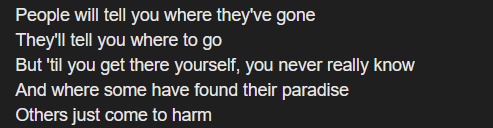
- Finally, I surround myself with people who view me generously and treat me kindly. I stay away from people who are champing at the bit to think the worst of me, who view everything I do through some kind of funhouse mirror. This means questioning accepted wisdom about certain spaces or people. A Joni Mitchell song I really love, "Amelia," contains these lines:
I also accept that these boundaries will not actually prevent me from being misunderstood and I try to resist engaging with the world from an anxious, crouched position. Instead, I just embrace being misunderstood – embrace being a villain, embrace having beef – because it's going to happen regardless. Even if I considered every angle, chose every word extremely carefully (and, like, I usually do!), that would not prevent me from misunderstanding or prevent others from projecting onto me what they'd like to see or what happens to be most convenient. And this is true for everyone, autistic or no. Life gets 1000% easier once you learn to just keep it moving rather than dwell on why some people just don't get you or can’t even conceive of you as a person.
It's also allowed me to be much easier on myself. I've long thought of myself as a failure – full of potential, never realized. And I don't anymore. I'm like "All things considered, you're doing GREAT." Instead of a failure, I think of myself as some kind of Tati-esque character fumbling my way through a bewildering universe. It's embarrassing but I endure!
Member discussion